
You have seen a number of states make efforts to tax the rich. Some are trying wealth taxes, some have relied on steeper graduated income taxes, some are using targeted property tax increases. Now, “Calirado,” which has become home to many former Californians over the last two decades, could follow the Golden State’s lead and ditch its hard won flat tax in favor of a graduated income tax in order to “stick it to the rich.” The effort is called Amendment 87, and would raise Colorado’s top marginal tax rate from the current 4.4% flat tax, to 8.4% for the highest income earners.
According to the new tax schedule, lower income earners would only see their taxes drop slightly, while high income earners would see their taxes nearly double.
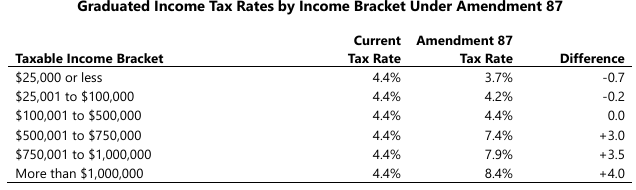
The Tax Foundation’s Jared Walczak explains the downsides of the proposal, writing:
Colorado’s 731,000 small businesses employ almost 49 percent of all Colorado employees, and the vast majority of these businesses are pass-through businesses (e.g., S corporations, partnerships, and LLCs), meaning that their income is taxed on owners’ individual income tax return. According to Internal Revenue Service data, of the state’s 53,640 filers with adjusted gross income above $500,000—those subject to higher marginal rates under the proposed tax increase—30,850 receive partnership or S corporation income, and 14,310 have other business or professional income. Households earning $500,000 or more earn 27 percent more in business income than they do in wage income. In other words, high tax rates on those with incomes above $500,000 function, to a considerable degree, as higher taxes on small business ownership.
Higher rates would reduce small business profitability and put Colorado’s small businesses at a competitive disadvantage against out-of-state rivals. The result would be some combination of reduced investment and growth, business attrition, lower wages, and higher prices.
Economic decisions are made on the margin. When the tax rate on the next dollar of income rises, business owners are likely to hire fewer workers, delay capital investment, and scale back expansion plans. They may also try to raise prices. (Whether they have the ability to raise prices will depend significantly on the conditions under which their competitors are operating.)
Colorado’s higher tax rates, moreover, would apply to many people who aren’t what we ordinarily think of as wealthy. Many filers will report $500,000 or more in income only once or twice, such as when they sell their business or an investment property. For them, this is a surtax on retirement or the return on many years of entrepreneurship and risk-taking, where most of the gains are realized at once rather than spread out over the many years of work that went into earning them.
Interestingly, Coloradans not only can defeat Amendment 87 by voting it down, but they can also cap the current flat tax at 4.4% by voting for Proposition 136. Walczak continues:
If both Amendment 87 and Proposition 136 pass, the one with the most votes would prevail on any conflicting provisions. This means that if both passed with Proposition 136 receiving more votes, graduated rate taxation would be permitted, but the top rate could not exceed 4.4 percent. A straightforward reading of both measures suggests that, if Proposition 136 received more votes, it would strike rates above 4.4 percent, leaving high income entirely untaxed given how the Proposition 87 statute is written. Such an outcome, however, is clearly not intended and would create other textual tensions, so it seems probable that courts would allow all higher income to be taxed at 4.4 percent. The state’s ballot information book (the “Blue Book”), however, acknowledges that the outcome of any conflict of the two measures is unclear and would have to be resolved by the courts.
Action Line: Now it remains to be seen if Coloradans will vote for higher taxes, vote for capping them, or maybe neither. Click here to subscribe to my free monthly Survive & Thrive letter.