You know that there are six major sources of electricity generation in America, from greatest to least generation, they are:
- Natural gas
- Nuclear
- Coal
- Wind
- Solar
- Hydroelectric
But, like the dying words of Master Yoda from Star Wars, “there is another,” source with great potential, geothermal. On public lands alone, the National Laboratory of the Rockies estimates that enhanced geothermal system resource potential could be massive. They write:
NLR estimates average EGS resource potential is 27 to 57 terawatt-electric (TWe) within 1 to 7 kilometers (km) depth across the United States. Of this, 4.35 TWe is on Bureau of Land Management (BLM) and U.S. Forest Service land, with 47.8 GWe considered economically developable. As of 2024, geothermal projects on public lands total 2,600 MWe of nameplate capacity. In 2022, 51 geothermal power plants on BLM-managed lands generated 11.1 terawatt-hours (TWh) of electricity.
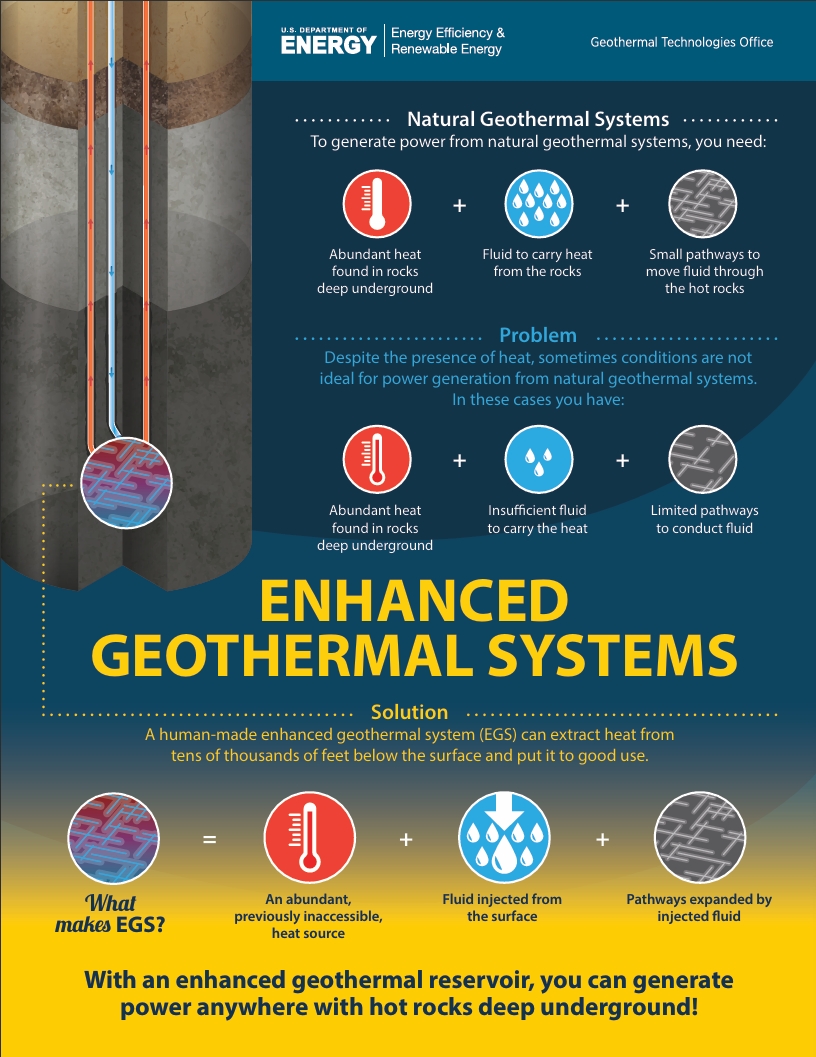
The U.S. Energy Department’s Office of Geothermal Research on Enhanced Geothermal Systems explains EGS, writing:
A naturally occurring geothermal system, known as a hydrothermal system, requires three key elements to generate electricity: heat, fluid, and permeability, which is when fluid can move freely through the underground rock.
In many areas, however, the underground rock is hot but there is not enough natural permeability or fluids present. In those cases, an enhanced geothermal system (EGS) can be used to create a human-made reservoir to tap that heat for energy.
In an EGS, fluid is injected deep underground under carefully controlled conditions to create new fractures and cause pre-existing fractures to re-open, creating permeability. Increased permeability allows fluid to circulate throughout the more fractured hot rock, and the fluid becomes hot as it circulates. Operators pump the hot water up to the surface, where it generates electricity for the grid. Watch a video to learn more about the steps and benefits in EGS development.
An illustration of a closed loop system power plant, where two wells reach deep into the subsurface and are connected to each other.
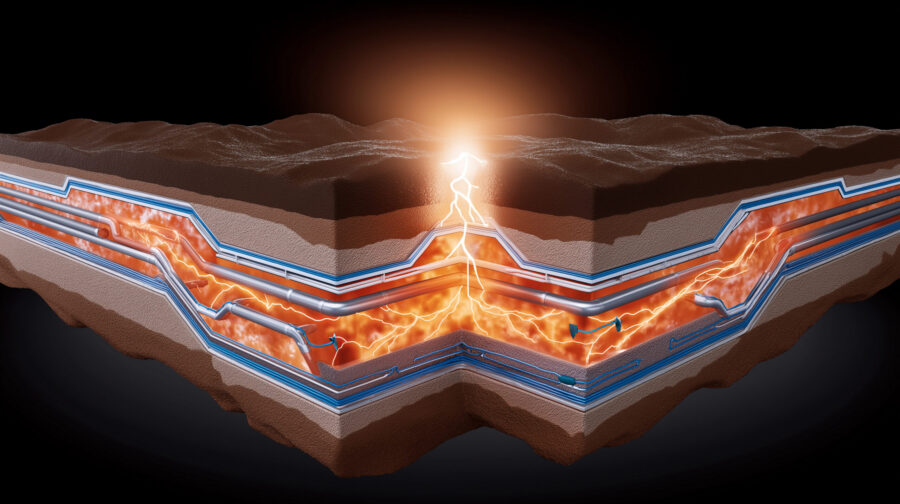
Illustration of a superhot geothermal power plant system, with two wells going deep into the subsurface connected via a superhot fracture network.
Other next-generation geothermal power generation technologies include closed loop geothermal systems and superhot geothermal systems. Closed loop geothermal systems do not rely on a fracture network. Instead, these systems are somewhat akin to a “radiator”—a series of closed pipes underground that circulate water and working fluids to absorb heat from the subsurface and bring it to the surface to produce power. Superhot geothermal systems tap resources at >375°C. Water injected into these extremely hot environments becomes so hot that it has the properties of both liquids and gases, allowing the superheated water to gather very large volumes of heat energy. At the surface, it can be used to produce power at several times the power density (amount of power per unit volume) than lower-temperature rock.
EGS and other next-generation geothermal technologies could facilitate geothermal development beyond traditional hydrothermal regions, thereby extending geothermal energy production nationwide. EGS advances are being demonstrated worldwide today, in both the public and private sectors.
Action Line: Can America derive a meaningful amount of energy from geothermal sources? Perhaps. The United States is already an energy heavyweight in the world, and adding additional supplies would only strengthen its position. Click here to subscribe to my free monthly Survive & Thrive letter.