
You don’t need anyone to tell you that power prices are climbing. The average retail residential price of electricity in the United States has climbed to 18.8 cents per kWh in April of 2026. Prices were only 7.73 cents per kWh in January of 2001. Remember, this is a regulated monopoly industry, and prices have still climbed 143% in 25 years.
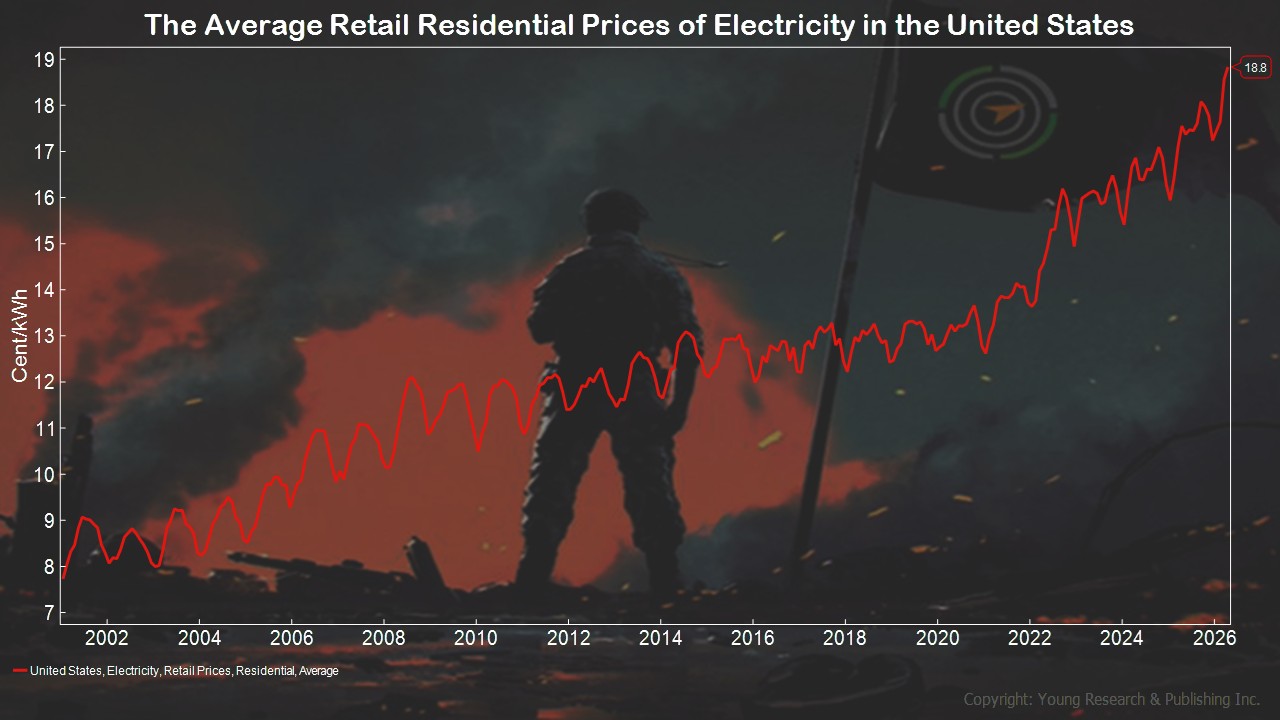
And the United States isn’t alone. Prices for electricity have climbed throughout the developed world. As a response, many homeowners have purchased their own power generation in the form of solar, and increasingly, they are adding battery storage. Felicity Bradstock reports at OilPrice.com:
It is not just in Australia that consumer interest in battery storage is increasing; uptake has risen worldwide in recent years. In the United States, home battery capacity grew by over 50 per cent last year, and the domestic battery market is expected to grow by around 120 per cent by 2030.
In Europe, solar power installations are helping to save consumers millions, particularly as gas prices continue to climb. One analysis suggests that solar power saved Europe over $115 million a day throughout March by reducing gas imports, savings that could climb to almost $78 billion by the end of the year if the Strait of Hormuz remains closed.
In addition to commercial solar power, households across the region are increasingly investing in residential installations to reduce their reliance on expensive electricity from the mains supply. Europe is the global leader in residential energy storage, accounting for 7 of the top 10 global residential storage markets, according to a December report from Wood Mackenzie.
Action Line: Price isn’t the only reason you might want some power put away in the battery pantry. Having some power tucked away when the lights go out can smooth out service in areas where outages happen often. Click here to subscribe to my free monthly Survive & Thrive letter.
Read the entire series here.