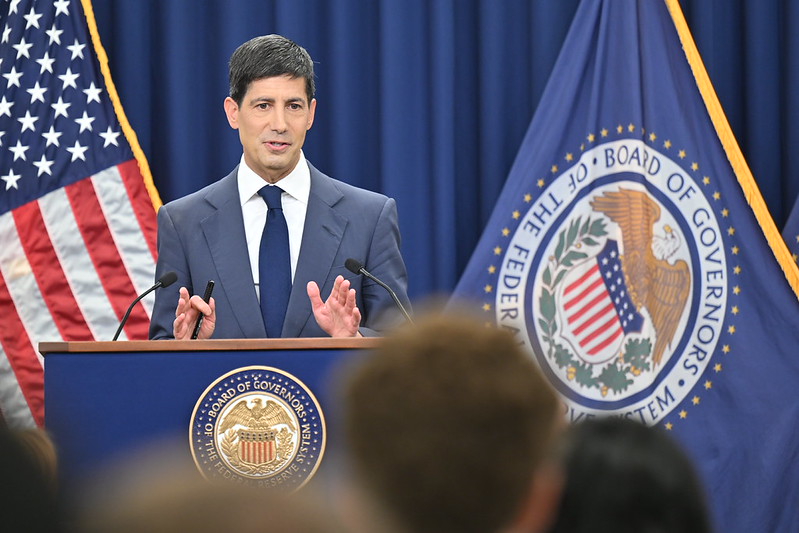
Federal Reserve Chairman Kevin Warsh is juggling many conflicting calls for action from his fellow Fed officials, President Trump, and market participants. They all have their own preferences on what Warsh should do with rates and monetary policy more broadly. At the Cato Institute, Jai Kedia adds one more priority to Warsh’s list: shrinking the Fed’s balance sheet. Kedia suggests that a task force appointed by Warsh should suggest he do just that. Kedia writes:
Before the 2008 financial crisis, the Fed’s balance sheet was small and consisted almost entirely of short-term Treasury securities. It has since grown to many times its historical size, peaking near $9 trillion in 2022 after successive rounds of quantitative easing.6 What began as an emergency response to two crises became a permanent feature of monetary policy, and the composition of the balance sheet changed along with its size. The Fed now holds large quantities of long-term Treasury securities and mortgage-backed securities (MBS), and it operates in an ample-reserves regime that requires it to pay interest on the reserves it created.7 The balance sheet task force is charged with examining that footprint and figuring out how to reduce it.
There are several problems with a large and broadly composed balance sheet. The Fed’s MBS holdings channel credit toward housing, favoring one sector of the economy over others in a form of credit allocation the central bank was never meant to perform.8 The ample-reserves framework requires the Fed to pay interest on reserves to affect its policy rate—a program that has cost the Fed billions, transferred risk-free income to large banks, and complicated the fight against inflation—because every rate increase raises the Fed’s interest expense.9 And this post-2008 operating framework makes it easier for the Fed to absorb federal debt, raising the risk of fiscal dominance, in which the Fed’s price stability mandate gives way to the government’s financing needs.10
The task force should endorse and accelerate a return to a smaller, simpler balance sheet. The Fed should continue reducing its holdings and prioritize running off its MBS portfolio, moving toward a balance sheet composed of Treasury securities.11 It should exit the ample-reserves regime and return to a framework in which it influences its policy rate through the open market for reserves rather than through interest payments to banks, which would allow the interest on reserves program to be wound down.12 To ensure that these solutions are permanent, Congress should place statutory limits on the size of the balance sheet and restrict the Fed’s purchases to short-term Treasury securities, thus closing the door to future rounds of open-ended asset purchases and to the credit allocation that MBS holdings represent. Obviously, where Congress places the limit on balance sheet size will be crucial; one option is to cap the Fed’s assets at 10 percent of total US commercial bank assets, which is roughly the ratio that existed pre-2008.
Fed officials have cautioned that shrinking the balance sheet is difficult and that a rapid sale of assets could strain financial stability.13 That caution is warranted, but it merely argues for a deliberate, well-communicated runoff rather than abrupt sales. It does not argue for leaving the balance sheet where it is. The Fed maintained a small, Treasury-only balance sheet for most of its history without incident, and a gradual return to that posture is well within its capacity. The goal is a balance sheet that supports monetary policy without further entangling the Fed in credit markets or in the financing of federal deficits.
Action Line: Your Survival Guy agrees with Kedia. The Fed’s balance sheet shouldn’t be a forever home for MBS like they’re some sort of abused animal. Nearly twenty years after the Financial Crisis, there shouldn’t be any suggestion that selling MBS is a “rapid runoff.” Click here to subscribe to my free monthly Survive & Thrive letter.