You have been reading my series about Putting Some Power Away in the Pantry. I want you to think about the reliability of your electricity supply and consider what it would take to keep the power on if the grid went down.
Your Survival Guy isn’t the only one thinking about how fragile America’s grid is today. The Department of War is reportedly preparing for power outages that could last 90 days at its bases. And it’s not just power outages; it’s food, water, fuel, and other necessities that could become scarce in the face of a major international war. Dani Oh of the IB Times reports:
The reported 90-day requirement extends beyond electricity to water, fuel and communications. At a 20 October 2026 Defense Writers Group roundtable, a senior defence official said the Pentagon was assessing energy requirements and costs across about 500 installations in the continental United States. No programme-wide completion date has been announced.
Secretary of War Pete Hegseth outlined the new policies during his State of the Force speech. Watch:
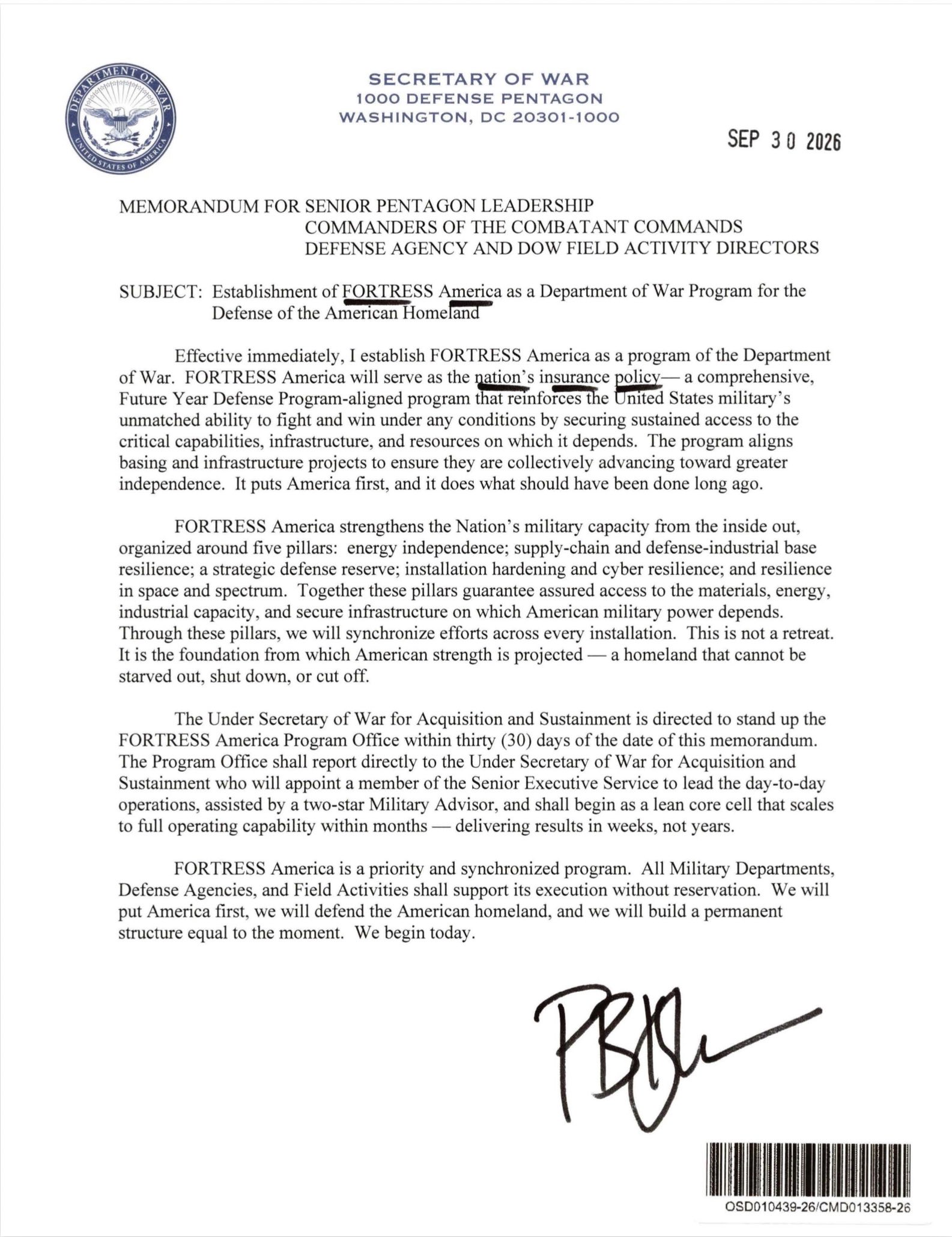
.@SECWAR “Today—at my direction—we are launching FORTRESS America—a national insurance policy for the American homeland.
FORTRESS stands for: Federal Operations for Resilience, Troop Resources, Energy, Supply, and Survivability.
And here is what FORTRESS calls for:
Every major military installation in America is going to generate its own power. Independent of the civilian grid. If an adversary takes down the grid—by cyberattack, by sabotage, by any means—our bases stay lit. Our aircraft keep flying. Our command centers never go dark.
We are bringing our critical supply chains home. The rare earths, the specialty metals, the semiconductors, the propellants—mined in America, refined in America, built in America, by American workers.”
— DOW Rapid Response (@DOWResponse) September 30, 2026
He also made it official with a memo dated September 30 explaining the goals of FORTRESS to Senior Pentagon Leadership:
Action Line: What should you do? Consider your own needs for ninety days. Do you have enough water? Food? Could you make your own electricity? Ninety days is a long time when it comes to self-sufficiency. If you have previously been relying on a go-bag with three days of food and water, expanding to ninety days of self-reliance in place is an exponentially more difficult and resource-intensive task. Start by putting some power away in your pantry, and by considering your own power situation. Do you have a generator? Solar? Batteries? Can you heat your house without power? Just how long can you last in a grid-down situation? Click here to subscribe to my free monthly Survive & Thrive letter.