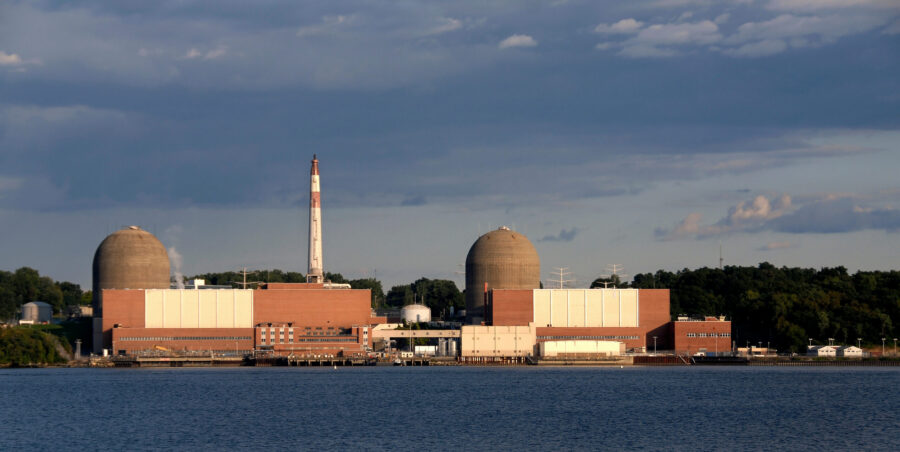
Five years ago, New York shut down the Indian Point Energy Center nuclear power facility located along the Hudson River below Peekskill, NY. There was no need to close it. The company that owned it wanted to extend its license for another 20 years, but the governor at the time, Andrew Cuomo, wanted it shut, and so it was.
Now, Cuomo’s successor, Kathy Hochul, who was his Lieutenant Governor before he resigned amid a scandal, wants to add more nuclear power to New York’s grid. It turns out, New York’s radical environmentalists couldn’t have their cake and eat it too. They couldn’t cut carbon emissions and remove all that nuclear power from the grid. Instead, they cut nuclear, and it was replaced by natural gas power plants, increasing New York’s carbon footprint.
Now, Gov. Hochul has overseen a dilution of the state’s strict environmental rules, and wants to bring back nuclear. Canary Media’s Alexander C. Kaufman reports:
Hochul, a Democrat who is up for reelection in November, watered down the state’s decarbonization goals this spring and is now calling for the biggest buildout of new nuclear reactors in decades.
“Expanding our nuclear energy capacity will play a key role in my all-of-the-above energy strategy to ensure we have enough reliable power to keep the lights on and costs down for New Yorkers while helping attract 21st century economic development opportunities,” Hochul said in a statement to Canary Media.
If successful, the 5 gigawatts of new nuclear power plants that Hochul aims to build would make New York the No. 3 state in the country in terms of atomic generating capacity.
New York’s ISO explained in its annual “Gold Book” report the damage that had been done by retiring Indian Point:
Rising wholesale prices over this period are best understood as the predictable result of current grid conditions as shaped in response to policies and other factors. The retirement of the Indian Point nuclear facility and large volumes of dispatchable generation, including peaking resources retired under DEC emissions regulations, combined with permitting impediments to repowering and new entry of fossil-based generation, has reduced available supply faster than it has been replaced. Markets do not create scarcity; they reveal it. When dispatchable capacity exits faster than it is replaced, prices rise to reflect increasing reliability risk and the cost of maintaining system security.
The report also explains that the only ways to achieve the state’s goals require nuclear power or unproven hydrogen-based power generation. The report explains:
For all scenarios that assume full compliance with various CLCPA goals, the study deploys either nuclear capacity or hydrogen-based generation as zero-emissions technologies to support emissions reduction objectives. These resources are assumed to provide the dispatchability and flexibility needed to replace the energy and reliability services fossil-fuel based generation currently delivers to the grid. But the 2025-2044 Outlook modeling highlights important economic trade-offs as well. In scenarios that allow fossil-fuel resources to operate beyond 2040, the models used in the study tend to select fossil generation over hydrogen-based alternatives, reflecting the higher relative costs associated with hydrogen under current assumptions. While all scenarios reinforce the need for resources that can deliver firm, flexible supply to the grid, these results help clarify the conditions under which emerging technologies may become competitive and the implications for long-term resource development pathways.
Of course, Hochul, who was part of the Cuomo administration responsible for Indian Point’s closure won’t admit that the government had anything to do with rising electricity prices. Instead she’s already blaming data centers, writing in a recent press release:
As energy demand surges across the state, New York State will advance a new initiative with a dual mandate: providing greater certainty and predictability for businesses seeking to invest in New York while ensuring that data centers pay their fair share. Unlike other sectors, data centers consume massive amounts of finite resources and place an unprecedented strain on the electric grid without creating many jobs in the process. Governor Hochul is taking action to ensure every day New Yorkers do not subsidize this energy intensive industry. To stop planning uncertainty caused by “phantom loads” and prevent rising costs for everyday consumers, the State will enforce a simple standard: these industries must pay more; if they do not, they must supply their own energy.
No surprise that Hochul is eager to pass the buck for New York’s anemic power generation. When politicians put their constituents’ needs and standard of living below their own personal political agendas, these situations occur. New Yorkers have suffered very high electricity prices while attempting to reach political goals that were unobtainable, and were finally pared back when politicians could no longer hide the obvious. No wonder so many people are fleeing New York for a better America.
Action Line: If you are looking for a new place to live where politicians put your needs ahead of their own agendas, begin your search with Your Survival Guy’s 2026 Super States. And click here to subscribe to my free monthly Survive & Thrive letter.