You know, I want you to know your risk tolerance. For many people, they don’t fully understand their risk tolerance until it has been tested by real-world events. Riding through market turmoil can tell you a lot more about your tolerance for risk than any questions about it ahead of time.
Perceived Future Risk Is Rising
In financial markets, one well known measure of risk is the CBOE’s Volatility Index (VIX). The VIX measures the expected standard deviation of the S&P 500 over the next thirty days. The higher the VIX, the greater the expected fluctuation (up or down) in the S&P 500. The lower the VIX, the less fluctuation is expected in the S&P 500.
The VIX has recently jumped quite a bit above its mean, though it’s still well within two standard deviations. CNBC’s Oliver Renick reported on the VIX spike, writing:
The Cboe Volatility Index (VIX) surged nearly 5 points to a high of 27.7 at the worst of Tuesday’s selling and the ratio of put to call volumes on the SPDR S&P 500 ETF (SPY) hit 1.5, the highest since the first week of April, according to Barchart data. The ‘VIX’ was last still hovering above 26.
With the VIX climbing four days in a row, the volatility gauge hasn’t traded under 16 since Oct. 16, arguably trending higher as the S&P 500 slips below this month’s lows, trading under 7,300 for the lowest price for the benchmark equity gauge since June. Cboe’s three-month volatility gauge, VIX3M, briefly touched the highest since April.
You can see the most recent jump in the VIX Index on my chart.
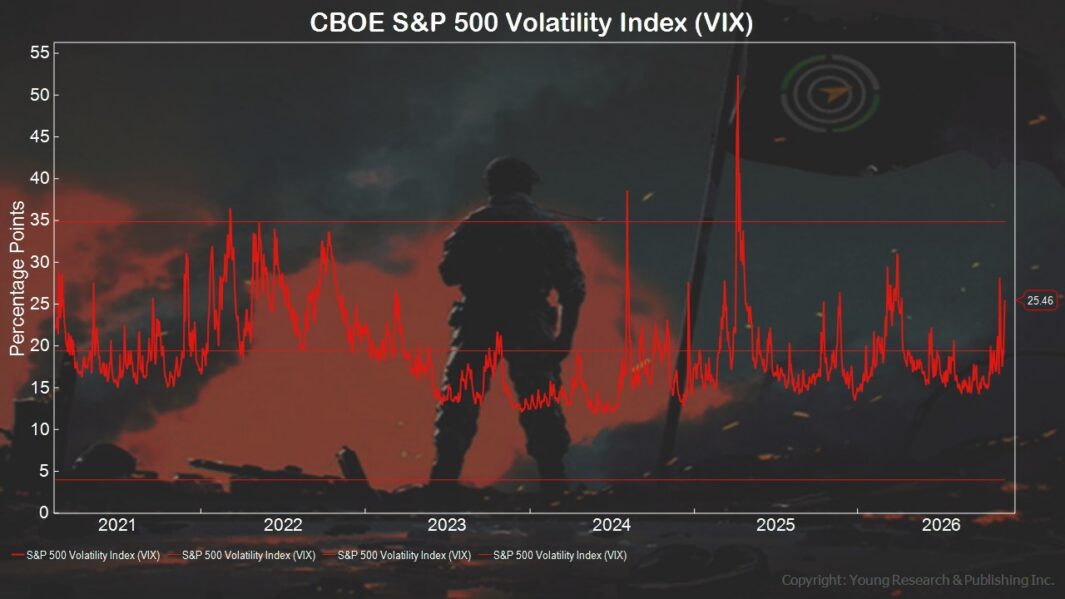
Fluctuations in the VIX Index aren’t a cause for panic. As you can see on my chart, there have been many such fluctuations since 2021. But when perceived risk is rising, it’s a good time to check your own risk tolerance and to make sure you’re invested accordingly.
Action Line: When you want to talk about your risk tolerance and an investment plan that reflects that tolerance, email me at ejsmith@yoursurvivalguy.com. And click here to subscribe to my free monthly Survive & Thrive letter.