
Dear Survivor,
You saved ‘til it hurt. You lived within your means. And now you wonder if you have enough money to retire. You’re ready to spend your savings somewhat foolishly. And in a word, it’s terrifying.
When you no longer have a paycheck to fall back on, it is scary. You’re not familiar with this version of yourself. But you’re ready to try to make it all work in your golden years.
It is not for the faint of heart. Understanding that you’re not alone in this endeavor is good for the soul. Now’s the time to have that long-awaited conversation, where you explain, “Honey, I think it’s time I retire.”
Avoid Some Big Retirement Mistakes, Ask for Help
When you think about your retirement life, it can sometimes come as a surprise. Stay with me here for a moment because it’s true. You never really feel like you have enough or that you’ve accomplished all that you wanted to accomplish.
It can be one of those things where you wake up one day and realize, “Self, I’ve had enough. I have enough. It’s time I retire.” Then the planning comes into play, and you begin to see what your retirement life will actually look like.
I have found investors benefit from having someone to guide them through this uncharted territory in life. Working with someone who’s seen it all can help you find your way by avoiding some big mistakes.
Time To Do a Little Housekeeping
It’s always a good idea to do a little housekeeping with your money. Sometimes it’s helpful to look back at how far you’ve come and consider not where you’re going but how you’re feeling.
If you’re in retirement or will soon be in retirement, do you have a rock solid handle on your spending? Are you living within your means? Are you able to spend four percent of your investable assets and still spend money somewhat foolishly?
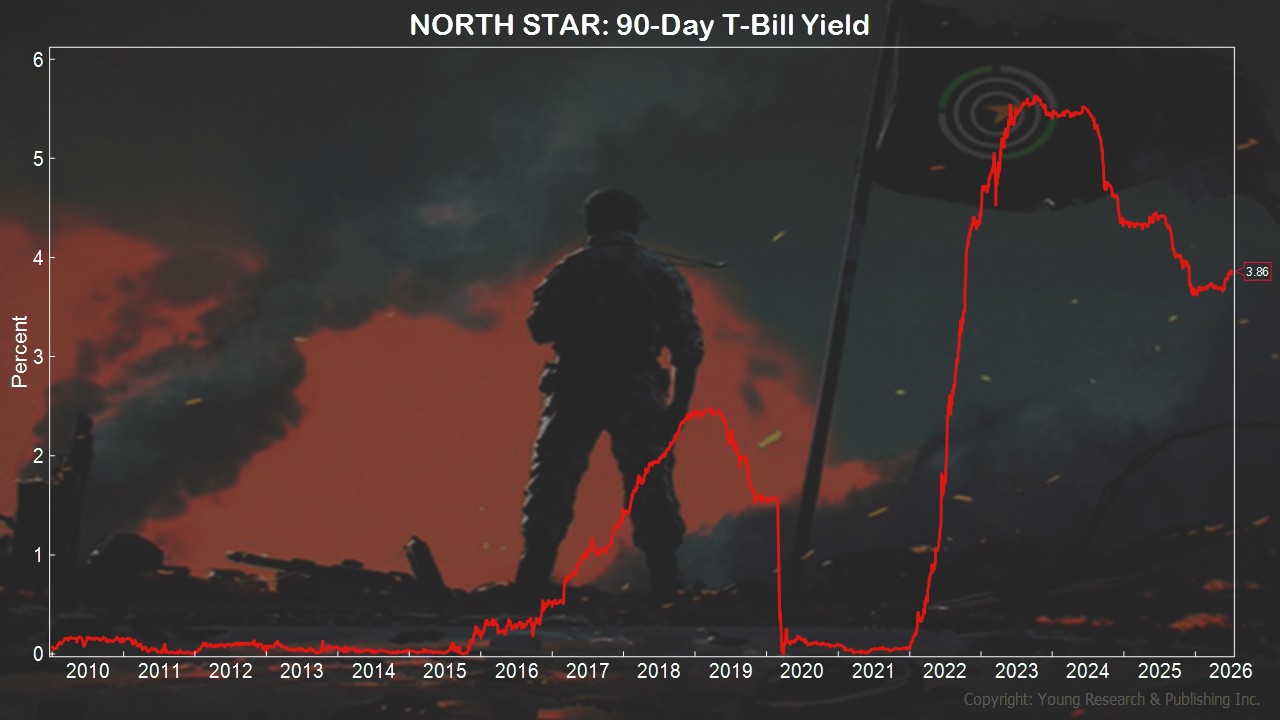
When market volatility throws a wrench into your plans, maybe it’s time to do a little housekeeping and reassess how you’re livin’. Begin your housekeeping with a look at the North Star, that is, Dick Young’s North Star, the risk free rate, and evaluate your comfort level with your other investments in relation to that.
Buffett “The Trick Is to Have a Very Long Hill”
You know that Warren Buffett and Dick Young made more money after age 65 than at any time before. Morgan Housel explained Buffett’s wealth after 65 to CNBC’s Lorie Konish, who writes:
“His skill is investing, but his secret is time,” Morgan Housel wrote in the bestselling business book, “The Psychology of Money.”
“That’s how compounding works,” Housel wrote.
To that point, 99% of Buffett’s net worth was accumulated after he was 65 years old, Housel said during a 2022 interview with CNBC.
“If Buffett retired at age 65, you would have never heard of him,” Housel said.
At the 1999 Berkshire Hathaway shareholders’ annual meeting, Buffett himself compared investing to a snowball rolling down a hill, and said: “The trick is to have a very long hill, which means starting very young or living … to be very old.”
The first step to rolling a snowball down a hill is getting to the top of the hill. That’s building your investment plan. Inertia makes getting started the hardest part.
Your Survival Guy and the Largest Great White
Your Survival Guy heard that the largest great white shark ever recorded is heading north towards the Cape, reported MSN.com:
The largest great white shark ever discovered in the Atlantic Ocean was spotted for the first time in months and is most likely heading toward Cape Cod and then the eastern coast of Canada, according to a group that researches the apex predators.
The 14-foot, 1,700-pound male shark named “Contender” was last spotted near the Outer Banks of North Carolina and is believed to be heading north towards the popular Massachusetts summer destination, according to OCEARCH’s shark tracker.
This got me thinking as I stood on the bow of our boat last weekend, considering going for a swim.
I know, the odds of getting attacked by a shark are about the same as being struck by lightning. But I know or have heard about a friend of a friend who’s been struck, and I’m sure you have too. So, thinking about the “odds” isn’t helpful to me.
I jumped in anyway, but I still couldn’t help thinking about what might be lurking below the surface. It’s hard not to.
Now, the largest great white I’ve ever seen attack a boat was in the movies. And it’s around this time of summer that I always watch parts of the movie Jaws. I don’t know why, I just do.
When it comes to investing, we spend a lot of time worrying about stuff that’s lurking below the surface. Worried about stuff that may never happen. That’s the nature of the beast. When you want to take a bite out of your investing worries, let me know. Email me at ejsmith@yoursurvivalguy.com.
Warm regards,

“Your Survival Guy”
- If someone forwarded this to you, and you want to learn more about Your Survival Guy, read about me here.
- If you would like to contact me and receive a response, please email me at ejsmith@yoursurvivalguy.com.
- Would you like to receive an email alert letting you know when Survive and Thrive is published each month? You can subscribe to my free email here.
P.S. Your Survival Guy understands that delayed gratification can allow you to spend your money somewhat foolishly later on in life. But some savers get so focused on putting money away and not spending that they have the ability to pay it forward to their families or their communities long after they’ve gone.
The current roster of Your Survival Guy’s “Save ‘Til It Hurts Hall of Fame” includes:
Now I’m inducting a fourth HoFer to the group, Iowa’s Dale Schroeder.
Dale Schroeder worked hard his whole life as a carpenter at Moehl Millwork in Des Moines, Iowa. As Dale got older, he realized he had some money he’d like to share with charity, nearly $3 million worth. After Dale’s passing in 2005, his family, friends, and lawyer established a 501(c)(3) and used his funds to send dozens of students to colleges in Iowa. The program ran from 2007 to 2015 and funded the education of 33 students. Now, “Dale’s Kids” are doctors, teachers, and more.
Dale Schroeder didn’t spend his money recklessly and saved ’til it hurt. Then, he paid it forward to give others the opportunity to thrive.
P.P.S. You know that for the last six years, Your Survival Guy has ranked the states in my Super States rankings. For five of those six years, New Hampshire has topped the rankings. But it’s not just me. Consumer Affairs has released its list of “The best states to move to in 2026,” and right at the top is the “Live Free or Die” state of New Hampshire. Consumer Affairs wrote:
New Hampshire finally rose to the top in 2026 after sitting as the second-best state on the list for the past two years. The Granite State ranks among the top states in several categories: It is second overall for safety and quality of life, and third in the healthcare and education category. Plus, New Hampshire does not collect state sales tax or individual income tax from its residents. Such well-rounded metrics — and a 2.8% unemployment rate, the fourth lowest in the country — make the state attractive to movers.
Along with New Hampshire in the top five were (in order), Utah, Idaho, Virginia, and Maine.
At the bottom of Consumer Affairs’s rankings are:
New Mexico
Louisiana
California
Arkansas
Oklahoma
Nevada
Alaska
Mississippi
Oregon
Arizona
The bottom states in Your Survival Guy’s Super States rankings are called the “Escape States.” They aren’t quite the same as Consumer Affairs’s list.
P.P.P.S. You know that California is contemplating a tax on residents’ wealth. The tax has already been reported to have driven some of the state’s billionaires to find homes in other states. At the Cato Institute, Adam N. Michel and Chris Edwards discuss the damage such wealth taxes can do, and their growing popularity around the world. They write:
Proposals to raise taxes on capital, and wealth in particular, have gained attention in US and global tax debates. In November 2026, California voters will decide whether to enact a one-time 5 percent tax on the worldwide net wealth of state residents with assets above $1 billion.2 At the federal level, Sen. Elizabeth Warren (D‑MA) has reintroduced her Ultra-Millionaire Tax Act and Sen. Bernie Sanders (D‑VT) has reintroduced his Make Billionaires Pay Their Fair Share Act.3 The Biden administration had pushed a “billionaire” minimum income tax proposal that would have imposed an annual 25 percent minimum tax on the income—including unrealized capital gains—of households worth more than $100 million.4 Other proposals from both Republicans and Democrats include higher taxes on the wage and capital income of well-off Americans.5
A parallel debate is unfolding internationally. After three decades of repealing wealth and estate taxes, and cutting other taxes on capital, some countries have started reversing these reforms. Norway raised its wealth tax rate in 2022, which led to a high-profile exodus of wealthy taxpayers to Switzerland. Spain expanded its wealth tax in 2022 through an additional Solidarity Tax on Large Fortunes. France abolished its broad wealth tax in 2018 but is debating whether to reimpose it. Under Brazil’s leadership, the G20 group of countries commissioned a proposal for a global minimum wealth tax on high-wealth individuals.6
Why do some policymakers want to raise taxes on wealth and capital? Warren says that she wants to address “runaway wealth concentration.”7 Sanders demands that “the wealthy and large corporations start paying their fair share of taxes.”8 The union-led California ballot initiative targets “excessive accumulations of wealth.”9 And global initiatives are justified with lofty promises of “social cohesion and trust in governments to work for the common good.”10
The top 10 percent of earners make 46 percent of US income but pay almost two-thirds of all federal taxes.
The US federal tax system is already highly progressive, meaning that it lands heavily on top earners. When considering all federal taxes—income, payroll, estate, and excise—US Treasury data show that the average effective tax rate for the top 0.1 percent of households is 33.4 percent, the rate for the middle 60 percent is 12.3 percent, and the rate for the bottom 20 percent is near zero. The top 10 percent earn 46 percent of US income but pay almost two-thirds of all federal taxes.11 A recent report by the Fraser Institute found that the United States has the most progressive tax system among major industrialized countries.12 Similar reports from the Organisation for Economic Co-operation and Development (OECD) and the left-leaning World Inequality Lab find that US taxes are more progressive than those in any other country studied.13
There is no agreement that progressive tax systems are fairer than systems that burden households in equal proportion to their incomes. But even if there were, the US tax system is already strongly tilted against high earners.14 A better way to increase tax fairness would be to end narrow tax breaks or loopholes for the wealthy, such as the income tax exemption for municipal bond interest and the deduction for state and local taxes.15
The idea that wealth can get “too concentrated” is something a child would imagine. It’s a fairytale. Wealth is grown; it’s created by productivity. The billionaires and “ultra-millionaires” being targeted with new taxes didn’t go around and steal their wealth from everyone else and hoard it under a mountain like the dragon Smaug in Tolkien’s The Hobbit. There are no dragons. The billionaires provided value to their customers who exchanged dollars representing their own previous or future productivity to get a good or service they wanted at a price they agreed to.
Once billionaires have wealth, it’s never just sitting in a pile; it’s invested or lent, allowing others’ businesses (or their own) to generate further value for society. There’s no magic pile of gold politicians can take from. Wealth is the fuel of America’s productivity. Take it away and spend it on wealth-destroying government programs, and it will sap the nation’s economic growth.
When you want to talk about your wealth and putting it to good use, email me at ejsmith@yoursurvivalguy.com.

Download this post as a PDF by clicking here.