You may have seen one of the more interesting stories coming out in the wake of the raid to snatch Venezuelan dictator Nicolas Maduro is the use of electronic warfare by American forces, specifically the use of the Boeing EA-18G Growler platform to deliver electronic warfare assets into the battle. The Wall Street Journal’s Alistair MacDonald reports:
Among the more than 150 U.S. warplanes that swarmed over Venezuela this past weekend was the Growler, a jet that attacks signals, not people.
The Boeing EA-18G Growler is a specialist in electronic warfare, a once neglected part of combat that has enjoyed a renaissance following its mass use in the Ukraine war. The Growler, which is flown by a Navy squadron nicknamed the “Zappers” and other naval units, likely played a key role in Venezuela, where air defenses were quickly overwhelmed.
In electronic warfare, communication, radar and other signals are targeted or protected.
The plane, based on Boeing’s F/A-18F Super Hornet, is a stalwart of U.S. electronic warfare, a field that mainly withered after the Cold War, said Thomas Withington, an electronic-warfare expert at the Royal United Services Institute think tank.
“The Growler forms the mainstay of U.S. air power’s EW component and would have located Venezuelan radars, jammed them and performed a similar task with military communications,” he said, referring to electronic warfare by its initials.
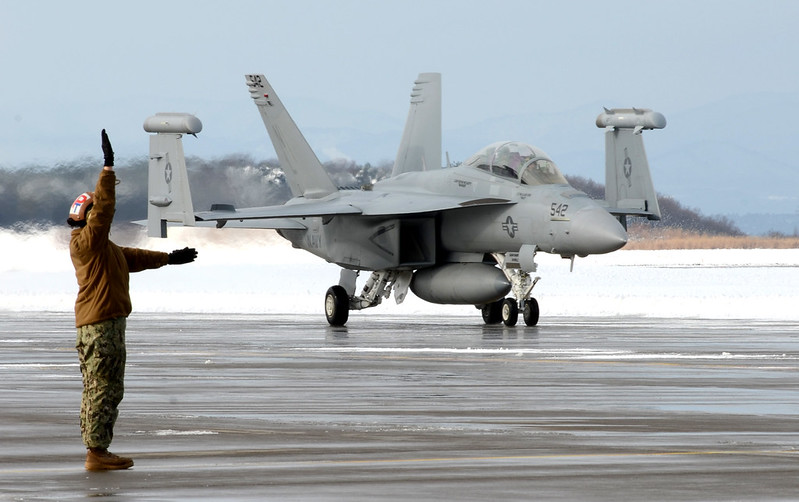
Boeing describes the Growler’s specifications as:
EA-18G Growler
Description and Purpose:
The EA-18G Growler conducts Airborne Electronic Attack (AEA) missions and is the most advanced AEA platform of its kind. A variant of the combat-proven F/A-18F Super Hornet, it combines the strike and defense capabilities of the Super Hornet with the latest AEA avionics suite to support mission success across the electromagnetic spectrum. All strike fighter aircraft rely on Growler escort to increase their survivability during high threat missions. The Growler’s advanced array of sensors and weapons provides the warfighter with a lethal and survivable weapon system to counter current and emerging threats.
Customer:
The EA-18G Growler is the U.S. Navy replacement for the EA-6B Prowler. The Navy provides electronic attack protection to all U.S. military forces and global allies.
- General Characteristics:
- Length: 60.2 ft (18.3 m)
- Height: 16 ft (4.9 m)
- Wing Span: 44.9 ft (13.7 m)
- Weight Empty: 33,094 lbs (15,011.2 kg)
- Recovery Weight: 48,000 lbs (21,772.4 kg)
- Internal Fuel: 13,940 lbs (6,323.1 kg)
- Max External Fuel: 9,744 lbs (4,419.8 kg)
- Engines (2) F414-GE-400
- Thrust 44,000 lbs
- Spot Factor 1.23
- Crew One Pilot, one Weapon Systems Officer
The AEA suite provides state-of-the-art selective-reactive and pre-emptive jamming capability. The majority of the AEA-unique avionics are installed on a pallet in the gun bay and in two wingtip pods. Nine weapon stations provide unique flexibility for carriage of weapons, jamming pods, and other stores to meet the needs for standoff jamming, escort jamming, time critical strike, or communications countermeasures. The AEA communications receiver and jamming system provide electronic suppression and attack against communication threats. These systems, combined with strike fighter aircraft with air-to-air and air-to-ground capabilities, yield a formidable and flexible capability with significant growth capacity for the future.
The Growler advanced cockpit combines with its onboard sensors and weapons to enable a superior Suppression of Enemy Air Defense (SEAD) capability. The active electronically scanned array APG-79 AESA radar offers increased electronic warfare support and is capable of precision targeting utilizing cues from the ALQ-218 precision receiver system. Integrating these systems with advanced weapons yields a more formidable SEAD capability than previously possible.
Background:
The EA-18G Growler Airborne Electronic Attack (AEA) system was selected by the U.S. Navy to replace the EA-6B Prowler aircraft. Boeing and the U.S. Navy signed a five-year System Development and Demonstration contract on Dec. 29, 2003. Northrop Grumman is the major supplier to Boeing for the AEA subsystem. The SDD contract encompassed all laboratory, ground and flight tests from component level testing through full-up EA-18G weapons system performance flight testing. The program leverages proven processes developed by the Super Hornet program to provide a low-risk executable program, on schedule, under weight, and on cost.
The Growler’s initial combat deployment occurred in late 2010 and concluded in mid-2011, supporting combat operations in Iraq and Libya. The Carl Vinson Strike Group took over support of maritime security and strike operations in Iraq and Syria in Fall 2014. Growlers and Super Hornets play a role in these ongoing operations.
Boeing, industry partners and the Navy are advancing the Growler to continue control of the electromagnetic spectrum to defeat future adversaries. The Growler is the only aircraft on contract for development and integration of the Next Generation Jammer. Other improvements, including an advanced mission system architecture and advanced data links will enable expanded long range passive targeting and multi-ship netted operations. The addition of conformal fuel tanks will provide even better range, persistence and bring back.

Watch the Growler in action: