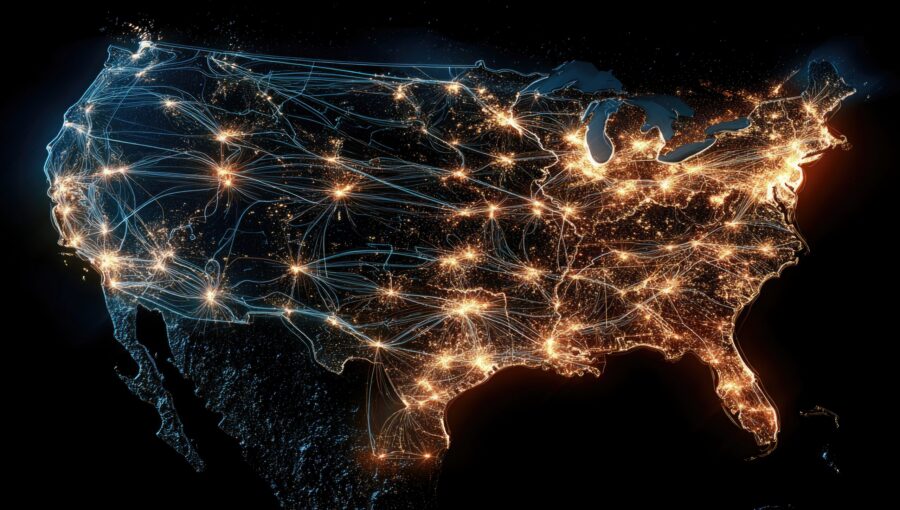
You know America needs power to supply the artificial intelligence buildout, and that electricity prices are high in many parts of the country, but Jonathan Lesser and Patrick McCormick explain for the National Center for Energy Analytics that data centers shouldn’t necessarily bear the blame for high energy costs. In the conclusion of their paper, titled “America’s Electricity Grids: At a Crossroads,” they write:
Data centers and other large loads have become convenient targets to blame for recent increases in electricity rates.[xlviii] That attribution is both overstated and counterproductive. Nevertheless, data-center growth is clearly a significant driver of rising electricity demand.
The rising data-center resistance movement advocates for banning or strictly limiting new data-center construction as the primary solution to our growing power challenges. Such measures have been proposed or advanced in numerous U.S. states and several European countries. In Europe, this stems partly from insufficient generating and grid capacity to accommodate rapid load growth alongside commitments to intermittent renewables as a means to meeting net-zero goals and partly because of physical concerns, such as water usage, and general concerns about Big Tech, including social-media harms, AI-driven job displacement, and privacy issues.[xlix] Along similar lines, legislation recently introduced in Congress calls for a moratorium on new data-center development until safeguards address not only higher electric rates but also increased carbon emissions, water consumption, and privacy risks.[l]
But limiting or banning data centers is ultimately self-defeating. Attempting to restrict technological advances in one location simply shifts those investments, jobs, and capabilities elsewhere. Europe is a clear example of this phenomenon, as traditional industrial facilities—from automobile manufacturers to chemical plants—are closing down.[li]
Large loads that develop fully private grids with no physical connection to the public grid will self-evidently bear the full cost of their power needs. By avoiding the lengthy interconnection requirements and contentious debates over cost allocation, such facilities can be built and brought online more quickly. This approach benefits society overall and protects consumers from rate increases. Many view fully separate private grids as a practical first step toward hybrid solutions. Speedy interconnections to public grids, where possible, can benefit both large loads and the grid itself.[lii]
For now, however, surveys show that a significant share (20%–50%) of forecast data centers plan to pursue some form of private grid solution.[liii] Ultimately, the mix of private, hybrid, or traditional public-grid approaches will depend largely on how quickly and effectively regulators at state and federal levels reform the complex approval processes required for connecting large loads to the public grid and, collaterally, for building or connecting new generation sources.
Whether by additions to the public grid or as a series of private grids, America has the ability to make and install electric equipment that will power the nation into a secure and prosperous future. We must demonstrate the collective will to meet the challenge.
Action Line: Read their entire paper here. And click here to subscribe to my free monthly Survive & Thrive letter.