You need to consider how dependent you are on electricity. If you’re like nearly every American, that’s a lot. And when the power goes off, the costs start rising. Oak Ridge National Laboratory estimates that the average yearly cost of all major outages was $67 billion over the seven years from 2018 to 2024. They reported:
Researchers at the Department of Energy’s Oak Ridge National Laboratory have provided the first comprehensive analysis of the specific costs of power outages to local customers across the nation. It found that the average yearly cost of major outages topped $67 billion over the past seven years.
The total annual burden on customers rose sharply over that time, with the price tag of major outages climbing to $121 billion in 2024. These power disruptions pose serious risks to public health and safety and drain billions of dollars from the U.S. economy.
Outage costs for multiple customer types in most counties were computed using publicly available government data sources combined with an existing, publicly available cost calculator, creating a new tool to help governments and utilities make decisions about grid modernization. It was recently incorporated in an ORNL-developed grid planning application called TASTI-GRID, short for Technical Assistance for States and Tribes Initiative: Grid Resilience Investment Decision-Making.
“When state energy officials can see the dollars and cents of outages in their particular areas, they can make better choices,” said ORNL lead researcher Narayan Bhusal. “This provides them even more information to meet their goal of striking the best balance between keeping rates affordable and having a reliable system. When a utility prioritizes the right high-value grid investments, its revenue will increase, customers will have shorter and fewer outages, and business customers will generate more income.”
Previous studies focused on utility costs or impacts on a single region or customer type. This is the first time a study has gauged the cost of unreliable electricity to customers nationwide, across geographic scales and customer types. The study evaluates the cost of major outages between 2018 and 2024, broken down by residential-and non-residential customers and by county in the 90% of counties with reliable data.
Where Do Power Outages Cost the Most?
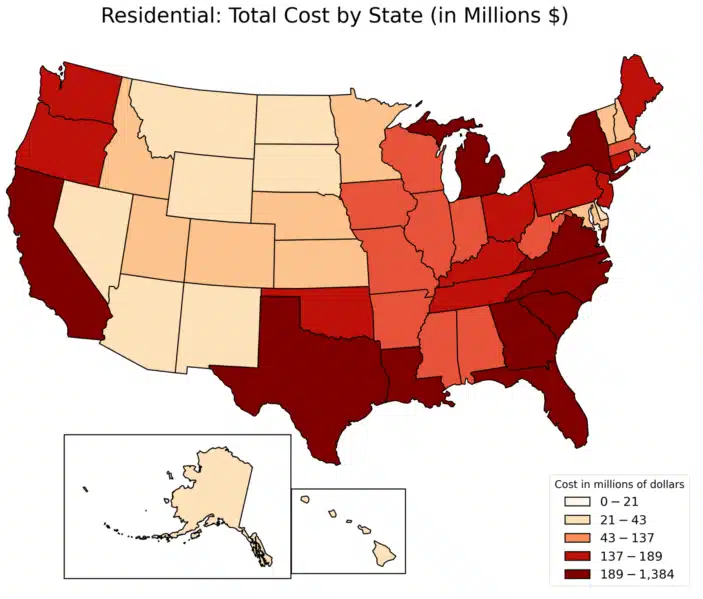
The costs of power outages aren’t the same everywhere. Oak Ridge provided a map highlighting the best and worst areas of the country for outage costs.
The total cost of outages to residential customers tended to be highest on the coasts. Credit: Narayan Bhusal/ORNL, U.S. Dept of Energy.
What You Can Do
If your power means the difference between producing or not, you need to consider ways to keep the lights on. For many, that could mean putting some power away in your pantry, i.e., battery storage, or even building your own home microgrid. What does that mean?
How the Energy Department Describes a Microgrid
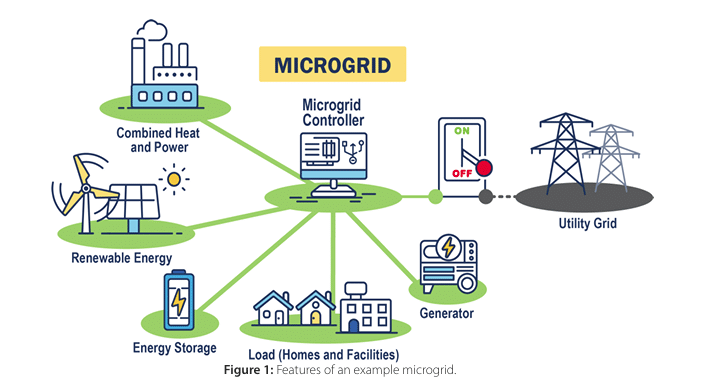
A microgrid is a group of interconnected loads and distributed energy resources within clearly defined electrical boundaries that acts as a single controllable entity with respect to the grid.2 A microgrid can operate in either grid-connected or in island mode, including entirely off-grid applications.
Figure 1 shows one example of a microgrid. Microgrids come in a wide variety of sizes and levels of complexity, but generally the key components include:
Electricity generation resources (e.g., solar arrays, diesel or natural gas generators, wind turbines)
Battery energy storage
Microgrid control systems: typically, microgrids are managed through a central controller that coordinates distributed energy resources, balances electrical loads, and is responsible for disconnection and reconnection of the microgrid to the main grid.
The Department of Energy is describing area microgrids, but you can develop something similar on your own property. An associate of mine who has solar, Powerwalls, and a generator told me the other day that his neighborhood was out of power, but that he didn’t even notice until he received a text. He was busy working away from home, being productive, with no time or money lost to an outage. Meanwhile, his neighbors who worked from home were scrambling.